

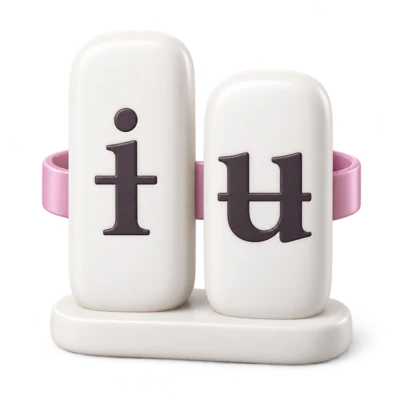
Learn barred phonetic symbols
Use the Barred symbols layout without assuming that a stroke has one fixed phonetic meaning. Compare central vowels, a front rounded vowel and several distinct consonants, then insert them through the verified key layers.
 VIDEO TUTORIAL
Compare barred vowel symbols
Use the Barred symbols keyboard and Shift layer to create a four-vowel reference line, then download it.
English narration Captions: English
Watch video
What you’ll learn
- Identify the qualities of ɨ, ʉ, ɵ and ø.
- Distinguish built-in barred letters from productive combining diacritics.
- Use the default and Shift keys while checking the resulting character.
A few symbols, a clearer picture
Close central vowels
Unrounded ɨ and rounded ʉ contrast in lip rounding.
Two close-mid rounded vowels
ɵ is central; ø is front. A bar-like feature does not make them equivalent.
Palatal consonants
ɟ is a voiced palatal plosive; ʄ is a voiced palatal implosive.
Velarized lateral
A velarized voiced alveolar lateral approximant, distinct from lateral fricative ɬ.
A visual collection, not a sound-changing rule
The stroke is part of the letter you select.
Read the explanation
Barred symbols is a convenient visual grouping. Its characters do not share one airstream, place or manner, and adding an arbitrary line to a Roman letter does not reliably create a new IPA value. Learn the encoded character together with its phonetic description. In this layout, each available key inserts the listed symbol rather than running a general bar-conversion algorithm.
This matters when copying between applications. ɫ is an established letter with a middle tilde, not simply an ordinary l with a cosmetic font effect. A combining diacritic and a built-in character are also different text representations. Use the actual supplied character and inspect its appearance after copying; do not substitute a lookalike merely because a line seems similar.
Schematic distinction: velarized lateral approximant versus voiceless lateral fricative.
Centrality, height and rounding
Compare one vowel dimension at a time.
Read the explanation
The close central vowels ɨ and ʉ differ in rounding: ɨ is unrounded and ʉ rounded. Their chart position is central, between the front and back reference regions. This is a vowel-quality description, not a universal rule about the written letters i and u. A language-specific transcription may use these symbols at a particular level of detail.
Both ɵ and ø are close-mid rounded vowels, but the former is central and the latter front. The default o key inserts ɵ; Shift with o inserts ø. Comparing these two with ʉ also separates height from rounding: a change in height need not mean a change in whether the lips are rounded. Keep each dimension explicit in your notes.
Schematic rounding contrast at close central quality.
Schematic central versus front contrast among close-mid rounded vowels.
Consonants require complete descriptions
Similar shapes do not imply a simple voiced pair.
Read the explanation
The character ħ is a voiceless pharyngeal fricative; h is normally described as a voiceless glottal fricative on the chart. Their difference is not that one is simply voiced. Likewise, ɟ is a voiced palatal plosive, while ʄ is a voiced palatal implosive. The latter distinction concerns the airstream mechanism as well as the character identity.
The Shift layer also contains ʡ and ʢ in the epiglottal region. Consult their full chart descriptions before using them in a transcription. The keyboard shows what can be inserted, not which articulation belongs in your recording. Square brackets indicate phonetic notation; a phonemic representation between slashes additionally requires a stated analysis of a particular language.
Schematic comparison: voiced palatal plosive versus voiced palatal implosive.
Build a four-vowel reference line
Choose a literal starting state
Open Barred symbols, position the caret and turn off Smart IPA suggestions for the drill. Leave Shift, Caps and Alt Gr off.
Insert close central vowels
Click i displaying ɨ, add a space in the editor, then u displaying ʉ and add another space. Check that the letters match their large key labels.
Insert central and front close-mid vowels
Click o displaying ɵ and add a space. Click on-screen Shift, then o displaying ø. Shift returns to the default layer after insertion.
Check the actual characters
Compare with the sample. Use Copy text or Download text and inspect the result at a readable size. Text style can improve visibility, but it does not change the characters.
Check your understanding
Try each question, then compare your reasoning with the explanation. These exercises stay on this page and do not change your editor text.
Keep identity separate from appearance
For searchable research data, retain the actual Unicode text and document the transcription convention. Check rendering in the receiving application; changing a font or substituting a visually similar letter can hide an unintended character change.
Listen to the IPA’s recorded chartListening opens the International Phonetic Association website. Exercises here practice notation and interpretation; they do not assess pronunciation.