

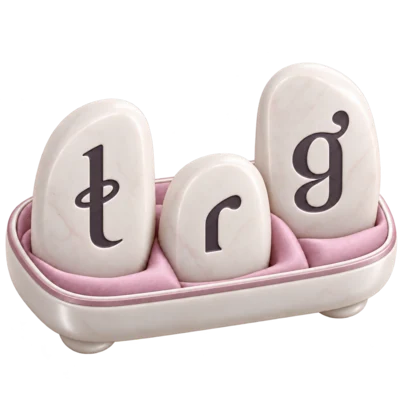
Learn the Extended symbols collection
Navigate a mixed collection of IPA consonants and vowels using their phonetic descriptions rather than the layout name. Practice the exact default and Shift keys while keeping this historical collection distinct from the specialist extIPA system.
 VIDEO TUTORIAL
Compare extended IPA symbols
Use base and shifted layers to assemble a lateral-and-vowel reference line and download the exact characters.
English narration Captions: English
Watch video
What you’ll learn
- Separate a keyboard collection from an official phonetic category.
- Distinguish lateral fricatives, implosives and vowel symbols in the collection.
- Build a comparison using verified default and Shift positions.
A few symbols, a clearer picture
Lateral fricatives
Voiceless and voiced alveolar lateral fricatives; neither is an ordinary lateral approximant.
Two front vowels
Near-open front unrounded æ and open-mid front rounded œ are different vowel qualities.
Two implosives
Voiced velar and voiced uvular implosives differ in place of articulation.
Rhotacized schwa
A schwa with rhoticity, not a general replacement for every written r.
What Extended means on this website
The name identifies a legacy collection, not an official class.
Read the explanation
Extended symbols groups together characters that are convenient to find on one keyboard. It includes vowels, lateral fricatives, implosives, approximants and other consonants. These sounds do not share one place or manner of articulation. Treat the layout as an address book for characters: the symbol description, not its folder, tells you what a character represents.
Do not equate this name with extIPA, the separate set of extensions used in specialist transcription of disordered speech. Nor is it a complete implementation of a Unicode block called IPA Extensions. Unicode organizes encoded characters; the IPA chart organizes phonetic notation. This layout is a selection that draws from several encoding locations and phonetic categories.
Schematic collection sample: lateral fricative, vowel and implosive; not one sound class.
Compare manner and voicing explicitly
A similar letter shape can conceal a different airflow pattern.
Read the explanation
The letters ɬ and ɮ form a voicing pair of alveolar lateral fricatives. Frication distinguishes them from the lateral approximant l. Their lateral description concerns airflow around the sides of the tongue, while fricative concerns the constriction and noise. A belt or loop in the printed form is a recognition aid, not a definition that can be applied to every related-looking letter.
The default g key supplies ɠ and the shifted g key supplies ʛ. These are voiced implosives at velar and uvular places, rather than ordinary voiced stops. Default r gives the alveolar tap ɾ; shifted r gives the alveolar approximant ɹ. For each comparison, ask separately about place, manner, voicing and airstream instead of guessing from the base letter.
Schematic voicing contrast within alveolar lateral fricatives.
Schematic manner contrast: alveolar tap and alveolar approximant.
Read vowels independently of spelling
Ligatures and hooks identify vowel qualities, not letter combinations.
Read the explanation
In IPA, œ represents an open-mid front rounded vowel; it is not an instruction to pronounce an o and an e in sequence. The vowel æ is near-open front and unrounded. Shifted o supplies ɶ, an open front rounded vowel. Rounding and height therefore need separate attention even when two symbols are associated with the same Roman key.
The shifted q key gives ɚ, while shifted e gives ɞ, an open-mid central rounded vowel. Their unfamiliar shapes do not make them interchangeable. Rhotacized vowels also need a stated transcription convention; a hook is not a universal claim about stress or spelling. Use square brackets for phonetic examples and reserve slashes for a phonemic analysis tied to a particular language.
Schematic height contrast between two front rounded vowels.
Assemble a lateral-and-vowel reference line
Prepare the layout
Open Extended symbols and position the caret. Turn off Smart IPA suggestions for this literal drill. Leave Shift, Caps and Alt Gr off.
Insert the lateral pair
Click l displaying ɬ and add a space. Click on-screen Shift, then l displaying ɮ. Shift returns to the default layer after insertion; add another space.
Insert the vowel comparison
Click a displaying æ, add a space, then o displaying œ and another space. Click Shift and then o displaying ɶ. Shift returns to the default layer after insertion.
Verify and preserve the text
Compare the five symbols with the sample. Use Copy text or Download text and check the result in a font that shows the lateral fricatives and vowel ligatures clearly.
Check your understanding
Try each question, then compare your reasoning with the explanation. These exercises stay on this page and do not change your editor text.
Build a source-based character inventory
For research notes, record the intended phonetic values and Unicode characters separately from the keyboard hints. Follow a language-specific transcription convention; the collection is a typing aid, not evidence that a speaker produces all its sounds.
Listen to the IPA’s recorded chartListening opens the International Phonetic Association website. Exercises here practice notation and interpretation; they do not assess pronunciation.