

Learn to find and evaluate minimal pairs
Use one-sound contrasts to make a focused phonetics lesson. Learn what the finder matches, how to review dictionary alternatives, and how to choose a clear set of examples.
 VIDEO TUTORIAL
Compare two sounds
Find written word pairs that differ by one sound.
English narration Captions: English
Watch video
What you’ll learn
- Explain why two written pronunciations form a one-phoneme contrast.
- Distinguish phoneme position, spelling and dictionary variation.
- Build a short reviewed word list for a learner or classroom.
A few symbols, a clearer picture
Change one vowel
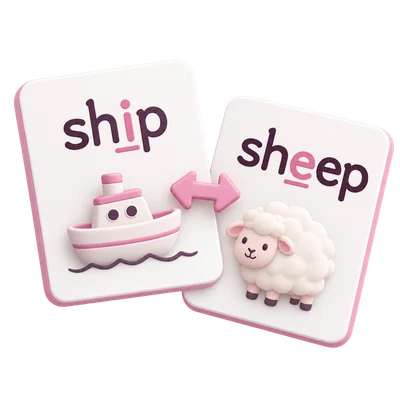
Ship and sheep share the same first and last phonemes in these broad US forms.
Change one consonant
Pat and bat illustrate a contrast at the beginning of the word.
Two letters, one unit
The dictionary treats the affricate CH as one phoneme, even though its IPA display has two letters.
Stress is a separate detail
The search ignores dictionary stress digits when matching; IPA still shows the chosen pronunciation.
Compare phonemes, not letter counts
The criterion concerns the stored sound sequence.
Read the explanation
The finder checks equal-length dictionary phoneme sequences and allows exactly one substitution: your first sound must be replaced by your second sound at the same position. All other phonemes must match. This excludes pairs that add a sound, delete a sound or change several sounds.
Ship and sheep have different spelling lengths, but both selected forms have three dictionary phonemes: SH IH P and SH IY P. The IPA display uses i without a length mark, following this site’s broad US convention. The search is not comparing how many Unicode letters appear on screen.
Only the middle phoneme changes.
Here the first phoneme changes, while the vowel and final consonant stay the same.
Make the scope of the contrast explicit
Choose a position and a pronunciation convention before interpreting a result.
Read the explanation
Contrast position refers to the first, last or an internal dictionary phoneme, not to a written letter or syllable. The syllable filter counts vowel nuclei in each candidate pronunciation. For an introductory exercise, choose one-syllable examples so the contrast is easy to see.
Stress digits are removed for matching. AH therefore groups forms displayed with ʌ and ə; ER groups ɝ and ɚ. This can be useful for finding candidates, but a narrow lesson may require inspecting the actual IPA rather than treating all menu choices as one fixed phonetic realization.
Some spellings have several dictionary pronunciations. When multiple combinations meet the search, a selector lets you choose which matching forms to keep. Dictionary order is not a frequency ranking and cannot choose a meaning for you.
A first-phoneme contrast under the selected broad convention.
Turn candidates into a useful lesson
A good word list is a deliberate selection.
Read the explanation
The dictionary contains names, inflections and rare vocabulary. Letter-only spellings removes entries containing punctuation; it does not make every remaining item familiar, suitable for children or relevant to your class. Review vocabulary and meaning before sharing a handout.
Use Include this word when you want a contrast involving a specific spelling. For a wider search, clear that field. Select only the pairs you want, inspect any pronunciation choices, and use copy, TSV or print. The first ten pairs are initially selected, but a selection can hold up to fifty across pages.
A written comparison can teach transcription and contrast analysis. It cannot establish how a learner hears or produces a sound. This tool contains no recordings or listening assessment.
Keep the learning goal clear before adding more vocabulary.
Build a ship–sheep contrast list
Set the sound contrast
Choose ɪ — ship as First sound and i — sheep as Second sound. Keep Contrast position at Anywhere in the word and choose 1 syllable.
Keep the example focused
Enter ship in Include this word, keep Letter-only spellings checked, and select Find minimal pairs. The ship / sheep example button applies these settings for you.
Read the match
Compare /ʃɪp/ and /ʃip/. The highlighted middle vowel changes, while /ʃ/ and /p/ remain. This search returns the ship–sheep pair in the site’s dictionary.
Review the selection
Keep the pair selected. For a wider lesson, clear Include this word and search again, then remove unfamiliar or unsuitable candidates with their checkboxes.
Save the list
Use Copy selected for a tab-separated list, Download TSV for a spreadsheet, or Print selected for a handout. Each option uses selected pairs, including selections on other pages.
Check your understanding
Try each question, then compare your reasoning with the explanation. These exercises stay on this page and do not change your editor text.
Use the list as evidence, not a frequency ranking
Document the variety and transcription convention when using dictionary candidates in coursework or research. The finder identifies a formal one-position difference after stress removal; a broader phonological claim also needs analysis of the language variety and relevant lexical meanings.
For teaching, keep a reviewed master list with the chosen IPA forms. TSV is useful for reordering or annotating that list in a spreadsheet. Print selected produces the compact list, while the guide’s written exercises check understanding of the method.
Searches run in the browser against this site’s existing dictionary files. Filter settings can return within the same tab session when storage is available; selected lists are temporary. Download a copy you want to keep.
Explore the official IPA chartThese exercises practice written notation and interpretation.