

Learn to search English words by sound and stress
Move from a phonetic teaching goal to a useful set of words. Search the pronunciation rather than its spelling, then combine sound position, syllable counts and stress patterns.
 VIDEO TUTORIAL
Find words by sound
Build a useful word list from a phonetic sound.
English narration Captions: English
Watch video
What you’ll learn
- Build an IPA query and distinguish sound position from spelling position.
- Interpret syllable counts and the 0, 1 and 2 stress notation.
- Review pronunciation variants and export a reproducible word list.
A few symbols, a clearer picture
A sound query
Searches the dictionary phoneme SH, regardless of the letters used to spell the word.
One vowel nucleus
This diphthong corresponds to one dictionary vowel phoneme and counts once for syllables.
Stress notation
0 is unstressed, 1 primary stress, and 2 secondary stress. Read the sequence from left to right.
A useful distinction
Here ə matches AH0; ʌ matches stressed AH. The sound search distinguishes the displayed qualities.
Write the sound you want to find
An IPA sequence searches pronunciation rather than spelling.
Read the explanation
Type a supported symbol, tap a key in the Vowels or Consonants sound keyboard, or use one of the example searches. Each sound key inserts at the cursor, replaces a selected range, and adds spaces when needed to keep neighboring phonemes separate. Space and Backspace help edit the sequence. Starts with and Ends with match the first or last dictionary phoneme sequence. Contains allows the same sequence anywhere in the word. Spaces are optional: s t and st request the same two-phoneme sequence.
The parser reads compact affricates tʃ and dʒ, and the listed diphthongs, as single dictionary phonemes. A space keeps phonemes separate: t ʃ requests T followed by SH, while tʃ requests CH. It accepts iː and uː as aliases for the site’s i and u convention. This is a broad US dictionary search, so symbols outside its inventory need another source or manual analysis; the tool explains an unsupported query instead of guessing.
Schwa ə specifically requests unstressed AH0. The symbol ʌ requests AH with primary or secondary stress. The r-colored vowels ɚ and ɝ are distinguished in the same way.
These three verified examples begin with the same dictionary phoneme.
Spaces improve readability without changing the sequence.
Use syllables and stress together
The count belongs to a pronunciation, not to the spelling alone.
Read the explanation
Each dictionary vowel nucleus carries a stress digit. The number of those nuclei supplies the syllable count. A diphthong such as aɪ counts as one. This method does not mark syllable boundaries and does not determine how many syllables a particular speaker produced in a recording.
Primary stress lets you request the first, last or next-to-last syllable. More filters adds an exact stress pattern. For 010, the tool requires three nuclei with primary stress on the second; both the first and last must be unstressed. A pattern containing 2 explicitly asks for secondary stress at that position.
All chosen filters apply together. If a two-syllable filter is combined with a three-digit stress pattern, no pronunciation can satisfy both. Relax one condition when a search is empty.
The stored form has two nuclei, with primary stress on the second.
The first nucleus has primary stress; the second is unstressed.
Keep variants and limits visible
A useful export preserves what was actually matched.
Read the explanation
Each result row represents one matching dictionary pronunciation. A spelling may have several rows if several alternatives satisfy your filters. Read the IPA and the stress digits together rather than assuming the first row is the most common form.
Results are alphabetical and can include names, inflections and uncommon vocabulary. Letter-only spellings removes punctuation-bearing entries; Spelling contains can narrow an activity to a particular letter sequence. Neither option is a frequency filter.
The tool retains up to one thousand rows and reports the total number of matching pronunciations. Copy results and Download TSV include all retained rows, across pages. If the total exceeds the retained count, narrow your search before treating the export as a complete set.
The TSV preserves both the chosen pronunciation and its filter evidence.
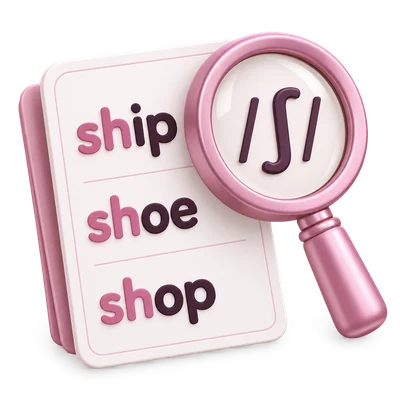
Find one-syllable words beginning with /ʃ/
Enter the initial sound
Type ʃ in IPA sound or sequence. Choose Starts with for Sound position. You can also select the Starts with /ʃ/ example.
Narrow the count
Choose 1 syllable and leave Primary stress at Any position. Keep Letter-only spellings checked. Leave the optional spelling and exact stress fields empty.
Run the search
Select Find words. The first search loads the site’s existing dictionary sections; the progress message reports loading and matching. Results then appear in pages of forty rows.
Inspect the examples
Find ship, shoe and shop in the alphabetical results or their downloaded TSV. Each row has one vowel nucleus and stress digit 1. The complete search also returns names and less familiar forms.
Save and refine
Download TSV retains all 651 pronunciation rows for this example in the current dictionary. For a smaller list, use Spelling contains or another sound sequence, then search again.
Check your understanding
Try each question, then compare your reasoning with the explanation. These exercises stay on this page and do not change your editor text.
Keep a reproducible search record
Record the IPA query, position, syllable filter and stress settings with a saved list. Distinguish a count of spellings from a count of pronunciation rows, especially when comparing two searches.
For a lesson, inspect meanings and choose words learners can use. For a phonological assignment, document the pronunciation variety and the decision to count dictionary vowel nuclei. The result does not establish speaker-specific syllabification or connected-speech behavior.
The search runs locally after downloading the site’s existing dictionary data. Filter settings can return in the same tab session when storage is available; results are not a permanent saved collection. Export a list you need to retain.
Explore the official IPA chartThese exercises practice written notation and interpretation.