

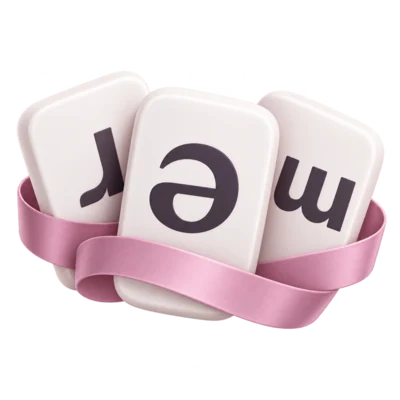
Learn turned and flipped phonetic symbols
Use visual relationships to locate characters while keeping their phonetic meanings separate. Practice a short sequence from the Flipped symbols layout and learn why a turned shape is a distinct character, not a transformed ordinary letter.
 VIDEO TUTORIAL
Find turned phonetic symbols
Choose three supplied glyphs from the Flipped symbols keyboard and preserve the exact characters in a text download.
English narration Captions: English
Watch video
What you’ll learn
- Identify ə, ɹ, ɯ and ʌ by their IPA roles rather than shape alone.
- Enter a supplied sequence using confirmed on-screen mappings.
- Explain why shape-based folders do not define official IPA sound classes.
A few symbols, a clearer picture
Schwa
A mid central vowel symbol; its shape is a cue, but it is not ordinary e displayed upside down.
Alveolar approximant
Distinct from trill r and tap ɾ; it is not a universal spelling for every sound written r.
Close back unrounded vowel
Its position and lack of rounding distinguish it from rounded u.
Open-mid back unrounded vowel
A vowel with its own IPA position, not the sound of Roman v played backward.
Use shape as a memory aid
A related outline can help you find a symbol without defining its sound.
Read the explanation
Phonetic alphabets use familiar letters alongside modified or turned forms. This layout groups several such shapes for convenient entry. On its base layer, e leads to ə, r to ɹ and m to ɯ. These associations help locate characters; turning a spoken e, r or m is not how the corresponding sound is produced.
The group mixes vowels and consonants with different articulatory descriptions. It is not an official IPA category, and the forms are not all literal rotations of their Roman hints. Verify targets against the chart. Knowing that ɯ is a close back unrounded vowel is more informative than remembering only its resemblance to a turned m.
A typing mnemonic, not a claim that a consonant becomes a vowel by rotation.
Contrast the actual phonetic values
Related-looking characters can differ in vowel quality or consonant manner.
Read the explanation
The vowels ə, ɯ and ʌ occupy different chart positions. Schwa is central; ɯ is close and back with no lip rounding; ʌ is open-mid and back with no rounding. These descriptions distinguish reference symbols. They do not prescribe the exact realization of every phoneme conventionally written with them in a particular language.
The IPA chart places ɹ in the alveolar approximant cell. It differs from trill r and tap ɾ, although all may be associated with an r-like category in some language. Do not assume a familiar spelling automatically calls for ɹ. A real transcription needs a stated variety, an analysis and, where relevant, additional phonetic detail.
An approximant and a trill have different manner descriptions.
The close back vowel pair differs in lip rounding.
Preserve the encoded character
The keyboard inserts symbols rather than rotating letters on the screen.
Read the explanation
Each output is a Unicode character that can be copied as text. Fonts may draw it somewhat differently without changing its identity. Rotating an image of e, however, creates a graphic rather than a Unicode ə. Use the character for editable, searchable transcription, and inspect a pasted sample if the destination font lacks a glyph.
The unshifted keys provide ə, ɹ, ɯ and other entries. Shift or Alt Gr reveals additional symbols; many positions remain blank. Disable Smart IPA suggestions for direct-entry practice and use the visible glyphs. The folder name helps navigate the inventory, but a phonetic task should specify the target character or articulatory description explicitly.
Verified base-layer mappings produce a vowel and a consonant.
Enter a mixed symbol sequence
Prepare the layout
Select Flipped symbols, uncheck Smart IPA suggestions and leave Shift and Alt Gr off.
Set the insertion point
Paste [] into a fresh editor line. Place the caret between the brackets so the three supplied symbols stay inside them.
Choose the glyphs
Click ə, ɹ and ɯ in that order. Their unshifted Roman hints are e, r and m. Check the large glyphs rather than expecting ordinary letters.
Inspect and copy
Confirm the sequence, then use Copy text. Paste it into your working document and check that the symbols remain distinct and legible.
Check your understanding
Try each question, then compare your reasoning with the explanation. These exercises stay on this page and do not change your editor text.
Using this in study or professional work
Pair mnemonic shapes with articulatory descriptions and reliable chart references in learner materials. For actual language data, state the transcription convention rather than treating a familiar shape as a pronunciation rule.
Listen to the IPA’s recorded chartListening opens the International Phonetic Association website. Exercises here practice notation and interpretation; they do not assess pronunciation.