

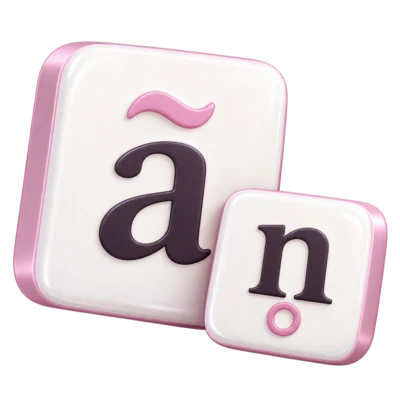
Learn IPA diacritics
Diacritics add a specified phonetic detail to a base symbol, such as nasalization, aspiration or syllabicity. Learn to choose meaningful marks and insert combining characters in the correct place without copying the chart's display circle.
 VIDEO TUTORIAL
Add IPA diacritics
Add combining diacritics to a base symbol and save your detailed IPA transcription.
English narration Captions: English
Watch video
What you’ll learn
- Interpret common diacritics in relation to their base symbols.
- Distinguish combining marks from spacing modifier letters.
- Build a short annotated sequence and inspect its copied Unicode text.
A few symbols, a clearer picture
Nasalized vowel
The combining tilde adds nasalization to a; it follows the base letter in the text.
Syllabic consonant
The mark below n indicates that the consonant serves as a syllable nucleus.
Aspiration
The modifier letter ʰ follows t to mark aspiration, not a separate full [h] segment.
Dental articulation
The diacritic specifies dental articulation for the base consonant.
Add a feature for a reason
A diacritic modifies an identified sound; it does not supply a complete transcription by itself.
Read the explanation
Start with the base sound and ask which extra detail matters for your purpose. Nasalization, voicing, tongue position and release can be represented with different marks. For example, ã adds nasalization to the vowel a, while t̪ specifies dental articulation for t. These are schematic examples of the notation, not claims about how every language pronounces those letters.
Detailed phonetic transcriptions commonly use square brackets and more diacritics than broad phonological transcriptions in slashes. More marks do not automatically make an analysis better. If a feature is unobserved, irrelevant to the task or already predictable under the stated convention, adding it can mislead the reader. Identify the language, context and intended detail before presenting an annotated form as evidence.
Schematic oral-versus-nasalized vowel comparison.
Schematic dental consonant; the mark refines the base symbol.
Separate articulation from syllable function
Marks can describe different dimensions of the same sound.
Read the explanation
The syllabic mark in n̩ says that the consonant is functioning as a syllable nucleus. It does not mean that n has become a vowel letter, is especially loud or is necessarily stressed. The non-syllabic mark in i̯ states the complementary kind of information: that this vowel-like element is not the syllable nucleus in the chosen analysis. Syllable function and stress must be considered separately.
Other marks concern production rather than syllable role. The raised h in tʰ indicates aspiration, while t̚ indicates no audible release. An aspiration mark is not simply an instruction to append an independent [h]. The chart also provides nasal release ⁿ and lateral release ˡ, plus marks for secondary articulations such as labialization ʷ and palatalization ʲ. Read the specific description rather than treating every superscript as a separate sound.
Schematic syllabic consonant versus non-syllabic vowel-like element.
Schematic aspiration versus no audible release; different production details.
Keep the text sequence and display distinct
The chart's dotted circle is a display aid, not part of the inserted transcription.
Read the explanation
Many IPA diacritics are Unicode combining marks. Enter the base first and then insert the mark immediately after it, without a space. The font positions the mark above or below the base. Other diacritics, including ʰ and ʲ, are spacing modifier letters. They still follow the relevant consonant in these examples, but they are encoded differently from a combining tilde or a ring below.
i2Speak displays a dotted circle behind a standalone combining mark so you can see it on the button. Selecting the button inserts the mark itself. A mark typed after a space may attach visually to that space or appear detached. Fonts and editing programs can also shape the same sequence differently. Check the pasted transcription in its destination, particularly stacked marks, rather than judging the character identity solely by appearance.
Schematic construction: base a followed by U+0303; the circle only illustrates the standalone mark.
Build three annotated sounds
Prepare literal entry
Open the Diacritics chart and begin an empty practice line in the editor. Turn off Smart IPA suggestions so typed base letters remain literal during this exercise.
Add nasalization
Type a, then select the nasalized tilde button. It shows a dotted circle on the chart, but your editor should contain ã without that circle.
Add syllabicity and aspiration
Type a space and n, then select syllabic. Type another space and t, then select aspirated ʰ. Keep each mark next to its intended base.
Inspect the saved sequence
Compare with the sample and use Copy text or Download text. Inspect the result in your destination; use Undo if a mark was inserted after the wrong base.
Check your understanding
Try each question, then compare your reasoning with the explanation. These exercises stay on this page and do not change your editor text.
Keep annotation interpretable
Provide a legend for unfamiliar marks and state your transcription scope. This typing aid does not assess speech.
Keep a Unicode text master. Check actual characters before replacing a sequence that merely displays poorly in one font.
Listen to the IPA’s recorded chartListening opens the International Phonetic Association website. Exercises here practice notation and interpretation; they do not assess pronunciation.