

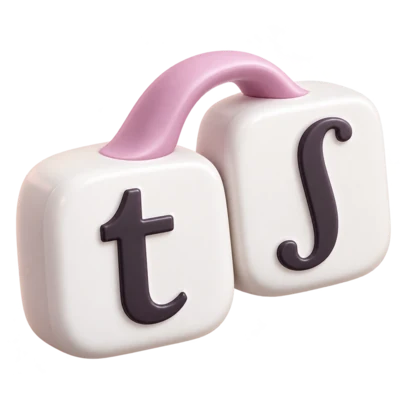
Learn affricates and tie bars
Read an affricate as a coordinated stop release into frication, while keeping phonetic description separate from phonemic analysis. Use the chart's complete tie-bar sequences and check their Unicode components when copying or editing.
 VIDEO TUTORIAL
Insert affricates with ties
Select affricate symbols, compare joined consonants, and save a useful reference line.
English narration Captions: English
Watch video
What you’ll learn
- Distinguish an intended affricate from an arbitrary stop-fricative sequence.
- Interpret the stop, fricative and tie-bar components of the chart buttons.
- Insert complete sequences without treating character count as a count of speech sounds.
A few symbols, a clearer picture
Alveolar affricate
A voiceless stop-to-fricative combination with an above tie bar.
Voiced alveolar counterpart
The voiced counterpart to t͡s in this schematic comparison.
Postalveolar affricate
A voiceless affricate represented by stop, tie bar and postalveolar fricative letters.
Voiced postalveolar counterpart
The voiced counterpart uses d and ʒ with the same tying convention.
An affricate has an integrated release
Stop closure and frication are coordinated parts of the production.
Read the explanation
An affricate begins with a complete oral closure and releases into a constriction that produces frication. The timing and coordination distinguish the intended affricate from an arbitrary list of a stop and a fricative. The notation records this relationship; it is not an instruction to pronounce two unrelated letter names or insert a pause between the components.
A sequence of written t and s can be ambiguous without context. A writer may omit a tie bar when the intended affricate is already clear, while another convention may use untied letters for a cluster. Do not conclude that every untied ts must be two separate phonemes, or that a tied phonetic representation proves a single phoneme in every language.
Schematic notation comparison: an explicit affricate versus an untied string whose interpretation requires context.
Compare the places and voicing pairs
The chart offers several stop-fricative combinations.
Read the explanation
The buttons t͡s and d͡z provide an alveolar voicing comparison. The t͡ʃ and d͡ʒ pair uses postalveolar fricative components. The chart also includes alveolo-palatal t͡ɕ and d͡ʑ, plus retroflex ʈ͡ʂ and ɖ͡ʐ. These distinctions matter even when a reader informally groups several of them under one familiar spelling.
A voicing comparison should hold the intended place and manner constant. Comparing t͡s with d͡ʒ changes more than voicing, because the fricative place differs as well. Treat the two component letters as a conventional description of the coordinated articulation, not as evidence that an affricate contains a pause or has twice the duration of another consonant.
Schematic voiceless and voiced alveolar pair.
Schematic voiceless and voiced retroflex pair supplied by the chart.
A segment and a text character are different units
The tie bar is a combining mark inside a sequence.
Read the explanation
The chart inserts t͡ʃ as three Unicode code points: t, U+0361 combining double inverted breve, and ʃ. This is not one precomposed letter. The combining mark displays as an above tie bar across neighboring letters in a suitable font. Official IPA notation also permits a below tie bar when needed; the buttons here use the above form.
A text counter can count encoded characters rather than phonetic segments. Copying into another application preserves a sequence, but fonts may position the combining mark differently. Editing may separate a component from its neighbors, so inspect the complete result after replacement or deletion. Square brackets identify phonetic examples; claims about phonemes between slashes require a language-specific analysis beyond the appearance of the bar.
Encoding illustration of the exact above-tie sequence inserted by the chart, not a pronunciation formula.
Build two explicit affricate pairs
Open Affricates
Choose Affricates from the chart links and position the caret. Each button inserts a complete sequence.
Insert the postalveolar pair
Click t͡ʃ and add a space in the editor. Click d͡ʒ, then add another space. Check both the fricative letter and the above tie bar.
Insert the alveolar pair
Click the alveolar voiceless affricate, add a space, then its voiced counterpart, following the final two sample items.
Check the copied sequence
Use Copy text or Download text. Inspect all four sequences in the receiving application with a phonetic font. If a tie bar looks displaced, check the actual characters before changing the transcription.
Check your understanding
Try each question, then compare your reasoning with the explanation. These exercises stay on this page and do not change your editor text.
Specify the convention and retain Unicode
State your tie-bar convention and transcription level. Retain the combining sequence, verify its font and distinguish phonetic grouping from a claim about phoneme number.
Listen to the IPA’s recorded chartListening opens the International Phonetic Association website. Exercises here practice notation and interpretation; they do not assess pronunciation.