

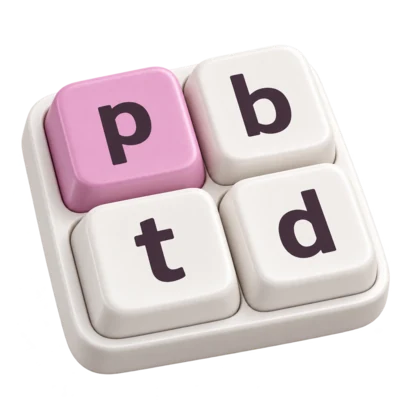
Learn the pulmonic consonant chart
Read the consonant table as a map of place, manner and voicing rather than a list of unfamiliar letters. Practice locating symbols and distinguish ordinary empty spaces from the standard chart's shaded articulations.
 VIDEO TUTORIAL
Compare consonant pairs
Compare consonants by place and manner of articulation, select symbols, and save your transcription.
English narration Captions: English
Watch video
What you’ll learn
- Locate a consonant by its place column and manner row.
- Interpret voiceless and voiced positions within a chart cell.
- Insert a controlled symbol comparison and explain the limits of the table.
A few symbols, a clearer picture
Bilabial plosives
A voiceless and voiced pair at the same place and manner.
Labiodental fricatives
A voicing pair whose place and manner differ from p and b.
Two nasals
Bilabial and alveolar voiced nasals illustrate a place contrast.
Two rhotic manners
The alveolar trill and alveolar approximant have different chart descriptions.
Read across for place and down for manner
The grid combines independent parts of a consonant description.
Read the explanation
Pulmonic consonants use a lung-driven airstream; the chart conventionally describes outward-flowing speech sounds. Across the table, places run from articulations near the lips toward the glottis. Down the table, manner rows distinguish plosives, nasals, trills, taps or flaps, fricatives, approximants and lateral categories. A cell therefore has two coordinates before its voicing position is considered.
To locate f, first find Labiodental, the region involving the lower lip and upper teeth, then Fricative. To locate p, use Bilabial and Plosive instead. Neither the letter shape nor an example word replaces these coordinates. The local table preserves the main chart structure with a selected set of base symbols; it is not a list of every consonant detail a narrow transcription could express.
Schematic comparison: both voiceless, but different in place and manner.
Interpret pairs, gaps and shading
A blank cell and a shaded cell make different statements.
Read the explanation
Where a cell contains two consonant symbols, the left member is voiceless and the right voiced. This convention explains p and b, f and v, or s and z. Do not transfer the vowel-chart convention, where paired positions concern rounding, into the consonant table. The header and row are still essential: being on the right does not tell you the place or manner.
In the official chart, shaded areas identify articulations judged impossible. An ordinary unshaded gap is not the same claim. A missing dedicated letter or button also does not prove that a related articulation cannot occur: diacritics and multi-symbol representations can provide more detail. Read the visual key before drawing a conclusion from a space, and avoid turning the table into an exhaustive language inventory.
Schematic voicing contrast within the bilabial plosive cell.
Schematic voicing contrast within the labiodental fricative cell.
Move from a chart value to a transcription
The chart describes sounds, while a language analysis supplies the context.
Read the explanation
The chart letter r denotes an alveolar trill, whereas ɹ denotes an alveolar approximant. Do not substitute a symbol merely because a word is spelled with the same Roman letter. A teaching hint can help you remember a shape, but the phonetic description is the safer reference when comparing languages or varieties. Consult the linked university demonstrations for actual articulatory examples.
Use square brackets for phonetic examples and slashes for a phonemic analysis that you explain. Choosing [p] does not specify every release or timing detail, and a broad representation need not mark every predictable feature. Decide the purpose of a transcription before adding detail. For a dataset or assignment, record the speaker variety and convention so a reader knows how to interpret your choices.
Schematic manner distinction: trill versus approximant, without an English-word pronunciation claim.
Make a two-cell voicing comparison
Open the table
Choose Pulmonic consonants from the chart links. Position the editor caret where the sequence should go; turn off Smart IPA suggestions for a literal drill if needed. On a narrow screen, scroll the table sideways to keep the headers in view.
Find the plosive pair
At Bilabial and Plosive, click p and then b. Add a space in the editor between the inserted symbols and after the pair.
Find the fricative pair
At Labiodental and Fricative, click f and then v, separating them with a space. Keep the order voiceless before voiced in each pair.
Check, then copy
Compare the editor sequence with the sample. Use Copy text or Download text. Describe each pair by place, manner and voicing before moving to another chart.
Check your understanding
Try each question, then compare your reasoning with the explanation. These exercises stay on this page and do not change your editor text.
Record a reproducible description
Use the table alongside a language-specific analysis and recordings. It can organize a transcription decision; it cannot establish a phoneme inventory or assess a person's speech from typed symbols.
Listen to the IPA’s recorded chartListening opens the International Phonetic Association website. Exercises here practice notation and interpretation; they do not assess pronunciation.