

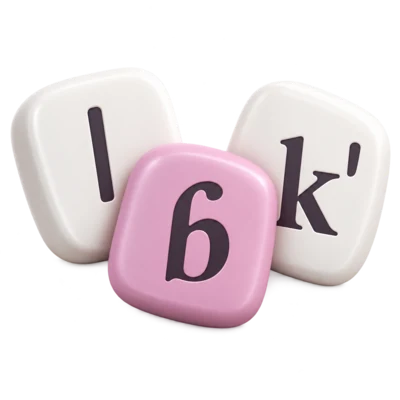
Learn non-pulmonic consonants
Distinguish clicks, voiced implosives and ejectives by their airstream mechanisms rather than by unfamiliar letter shapes. Practice exact chart symbols and learn an important Unicode limitation in the legacy ejective buttons.
 VIDEO TUTORIAL
Explore clicks and implosives
Find clicks, implosives and ejectives, insert the symbols you need, and save your notes.
English narration Captions: English
Watch video
What you’ll learn
- Distinguish click, implosive and ejective mechanisms.
- Separate a click type from accompanying laryngeal or nasal information.
- Insert chart symbols while recognizing different apostrophe code points.
A few symbols, a clearer picture
Click types
Dental and alveolar lateral click letters, not ordinary punctuation bars.
Voiced implosives
Bilabial and dental/alveolar implosives differ in place of articulation.
Further implosive places
Palatal and velar voiced implosives extend the place comparison.
Ejective notation
Standard modifier apostrophe U+02BC follows k; the legacy button currently inserts k’ with U+2019.
Compare the pressure-generating actions
Non-pulmonic does not mean that every sound is inward.
Read the explanation
Clicks involve a pressure change in a pocket of air enclosed by oral closures, with an inward release at the front closure. Ejectives use a glottalic egressive mechanism: pressure above a closed glottis increases before release. The source of pressure therefore differs from the ordinary lung-driven airstream, even though ejective release is outward.
Implosives involve laryngeal lowering that expands the space above the glottis; the chart lists voiced implosive letters. Do not reduce this category to an instruction to inhale a whole syllable. Airstream labels describe pressure-generating mechanisms, not simple breathing exercises. Use the linked demonstrations for comparison rather than forcing an unfamiliar articulation from a printed symbol.
Schematic comparison: dental click type versus voiced bilabial implosive.
Read click type separately from accompaniment
A base click letter does not specify every property.
Read the explanation
The chart gives bilabial ʘ, dental ǀ, (post)alveolar ǃ, palatoalveolar ǂ and alveolar lateral ǁ click categories. Their vertical strokes and exclamation-like forms are phonetic letters, not separators or expressive punctuation. Preserve the actual Unicode characters in a dataset rather than replacing them with familiar keyboard lookalikes that happen to resemble them.
Click consonants can also differ in voicing, nasalization and aspiration. A base click letter alone does not state every accompaniment or establish a language inventory. The Berkeley exercises include voiceless, voiced and nasal click demonstrations. Follow a language-specific transcription convention when adding these properties, rather than assuming one button supplies a complete description of every possible click.
Schematic click-type comparison: dental followed by alveolar lateral.
Distinguish modifier letters from punctuation
Apostrophe shape is not enough to identify the text.
Read the explanation
Standard ejective notation places modifier-letter apostrophe ʼ after the consonant, as in kʼ. Unicode identifies this as U+02BC and distinguishes it from right single quotation mark U+2019. The current legacy chart buttons insert the punctuation character, giving forms such as k’. This guide reports that behavior without claiming the two encoded strings are identical.
For a publication or searchable corpus, check the required character before copying an ejective example. The standard modifier-letter example here can be copied separately; it is not the unchanged chart button's output. Square brackets mark phonetic notation, while slashes require a stated phonemic analysis. Neither similar typography nor a successful copy establishes the correctness of an analysis.
Encoding comparison: modifier-letter apostrophe U+02BC versus legacy punctuation U+2019.
Create a click-and-implosive reference line
Open the chart
Choose Non-pulmonic consonants from the chart links. Position the caret where the drill should begin. Use chart groups directly instead of guessing Roman-key conversions.
Select two click letters
In Clicks, click ǀ and then ǁ, adding a space in the editor between them and after the pair. Check the actual click letters rather than plain vertical bars.
Add two implosives
In Voiced implosives, click ɓ and then ɗ, separated by a space. These compare two places within the same chart group.
Inspect and copy
Compare with the sample and use Copy text. This literal drill deliberately avoids ejective buttons. Consult the Unicode note before preparing an ejective transcription for reuse.
Check your understanding
Try each question, then compare your reasoning with the explanation. These exercises stay on this page and do not change your editor text.
Record airstream and encoding choices
Document the intended category and exact characters in teaching or annotation. The linked university resource supplies external demonstrations; i2Speak inserts symbols and does not play sounds or score a speaker's production.
Listen to the IPA’s recorded chartListening opens the International Phonetic Association website. Exercises here practice notation and interpretation; they do not assess pronunciation.